
Posts

Patch available: VMware vSphere 5.5 U1 NFS APD bug

In April 2014 was a bug in vSphere 5.5 U1 discovered, which can lead to APD events with NFS datastores.iSCSI, FC or FCoE aren’t affected by this bug, but potentially every NFS installation running vSphere 5.5 U1 was at risk. This bug is described in KB2076392. Luckily none of my customers ran into this bug, but this is more due to the fact, that most of my customers use FC/ FCoE or iSCSI. Until today the only solution was to avoid the upgrade to U1 and to use vSphere 5.5 GA (with some patches to fix the Heartbleed bug).
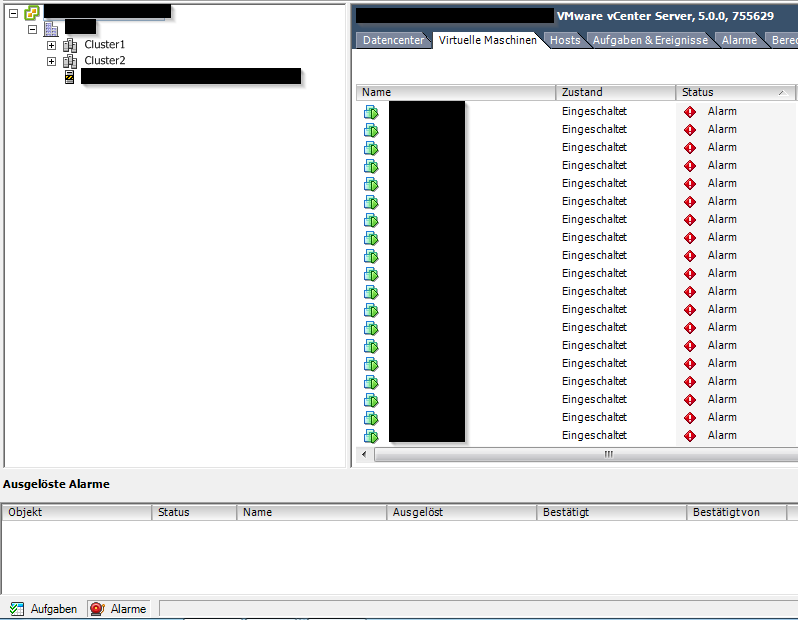
VM shows alarm - but no alarm triggered

Today I observed a strange behaviour of several VMs at a customer. Several VMs in a cluster showed an alarm, but neither on the alarm tab of the VM, nor the alarm section at the bottom of the C# client showed an error.

Patrick Terlisten/ vcloudnine.de/ Creative Commons CC0

Patrick Terlisten/ vcloudnine.de/ Creative Commons CC0

The customer still uses vSphere 5.0. An upgrade to 5.5 is on the roadmap. The symptoms:

TeamViewer Connection with Royal TS

Some of my customers use TeamViewer to provide a quick access to their systems, without the need to configure VPN connections, install software on hosts etc. TeamViewer provides fast and secure access without the need to install software. Simply start the teamviewer.exe and choose if you want to connect to a host or use the session id and password to allow someone else access your computer. TeamViewer is free for all non-commercial users! So it’s a great choice for remote support all your family members.

Configuring HP StoreOnce VSA and HP Data Protector for HP StoreOnce Catalyst

HP StoreOnce Catalyst is an enterprise-wide deduplication algorithm which is used in HP StoreOnce appliances, HP StoreOnce VSA and HP Data Protector. With StoreOnce Catalyst, deduplicated data can be moved between Catalyst capable devices without the need to rehydrate the data. Think about the backup in your remote location. You can move the deduplicated data to your central StoreOnce appliance in your HQ without rehydrating the data. This saves bandwidth and time. Or think about source-side deduplication, which means that a server deduplicates the data during the backup and sends the deduplicated data to the backup device. This saves bandwidth and increases the performance (with the downside of more cpu load on the server…).

Conflicting information: Setting iops option for VMW_PSP_RR for HP 3PAR StoreServ on ESXi

Yesterday I received the following tweet:

Later Craig Kilborn joined the conversation and I decided to clarify this 100 or 1 IOPS myth the next morning.

In order to give you some context: I wrote a blog post about adding a custom SATP claimrule for HP 3PAR StoreServ storage on ESXi. In this blog post I pointed out, that the claim rule is usually used to change the default behaviour for switching the path for active IO. For the VMW_PSP_RR this is 1000 IOPS, which means, that after 1000 IOPS for a specific device, the path for the active IO to this device ist changed to the next active and optimized IO path. I recommend to read this blog post from Duncan Epping for more information.

Royal TS - Remote connection management for Windows

Disclaimer: I use a NFR license that was provided to me as a vExpert by code4ward free of charge.

I have searched for a relatively long time for a solution to manage multiple remote connections, like RDP, VNC or SSH. I tried different free tools, but none of them fulfilled my requirements, which are quite simple: Manage different connections & credentials. First I’ve tried Devolutions Remote Desktop Manager, which was quite good. But to be honest: It was a bit too much for my needs. Justin Paul wrote a nice review of Remote Desktop Manager. The second product I’ve tested was more suitable: Royal TS for Windows.

Add custom SATP claimrule for HP 3PAR to VMware ESXi

One of the tasks that I finish before I present the first Virtual Volumes (VV) to hosts is to discuss the need of a custom SATP claimrule with the customer. Requirement for a custom claimrule is usually, that the active and optimized path should be switched after each IO and not after 1000 IOs. Duncan Epping wrote a nice blog post some years ago. I recommend to read it.

Some basics

The Storage Array Type Plug-In (SATP) is responsable for array-specific operations, like health monitoring of physical paths, reporting of path state changes and path failover. Each SATP is linked to a Path Selection Policy (PSP), which controls the selection of active paths for IO. VMware ESXi provides a couple of SATPs:

Some thoughts about HP 3PAR Adaptive Optimization

HP 3PAR Adaptive Optimization (AO) enables autonomic storage tiering on HP 3PAR storage arrays. With this feature the HP 3PAR storage system analyzes IO and then migrates regions of 128 MB between different storage tiers. Frequently accessed regions of volumes are moved to higher tiers, less frequently accessed regions are shifted to lower tiers. I often talk with customers about AO and I know that this feature is sometimes misunderstood and misconfigured. This blog post is a summary of in my opinion important topics.

Event ID 4625 - Failure Reason: Domain sid inconsistent

The last two days I had a lot of trouble with Microsoft Remote Desktop Services (RDP), or to use the older wording, terminal services. To be honest: Terminal servers are not really my specialty, and actually I was at the customer to help him with some vSphere related changes. But because I was there, I was asked to throw a closer look at some problems with their Microsoft Windows 2008 R2 based terminal server farm. Some problems with removable media (USB sticks etc.) and audio on IGEL thin clients were hard to troubleshoot, but we were able to fix them. The main problem was none at first glance.

Power on HP ProLiant servers with iLO, SSH & Plink

Some weeks ago, Frank Denneman wrote a short blog post about accessing his Supermicro IPMI with SSH. He used this access to power on his lab servers.I don’t use Supermicro boards in my lab, but I have four HP ProLiants with iLO and iLO has a also a SSH interface. This way to power on my servers seemed very practical, especially because the iLO web interface isn’t the fastest. But I wanted it a bit more automated, so I decided to use Plink to send commands via SSH.