Linux

Load Balancing inbound SMTP connection with HAProxy

In my last blog post I have highlighted how HAProxy can be used to distribute client connections to two or more servers with Exchange 2013 CAS role. But there is another common use case for load balancers in a Exchange environment: SMTP. Let’s take a look at this drawing:

Patrick Terlisten/ vcloudnine.de/ Creative Commons CC0

Patrick Terlisten/ vcloudnine.de/ Creative Commons CC0

The inbound SMTP connections are distributed to two Mail Transfer Agents (often a cluster of appliances, like Cisco IronPort or Symantec Messaging Gateway) and the MTAs forward the e-mails to the Exchange servers. Sometimes the e-mails are not directly forwarded to the Exchange servers, but to mail security appliances instead (like Zertificon Z1 SecureMail Gateway). After the e-mails have been processed by the mail security appliances, they are forwarded to the Exchange backend. Such setups are quite common. If a load balancer isn’t used, the MX records often point to the public IP address of a specific MTA. In this case, two or more MX records have to be set to ensure that e-mails can be received, even if a MTA fails.

Load Balancing Microsoft Exchange 2013 with HAProxy

Since Exchange 2007 client connections are handled by the Client Access Server role. With Exchange 2010, Microsoft has introduced the concept of the Client Access Server Array (CAS Array). A CAS Array is required, when internal and external client connections should be load balanced over multiple client access servers. Many client access protocols in Exchange 2010 require session affinity. This means, that the connection between the client and a particular client access server must persist. This requires application-level load balancing for Exchange 2010 and Microsoft recommends this explicitly. Microsoft dropped the concept of the CAS Array in Exchange 2013 and implemented much more logic into the Exchange 2013 Client Access Server role. There is no more need for session affinity in any client access protocol used in Microsoft Exchange 2013. Connections to a Exchange 2013 client access servers can be directed to an available server. A simple DNS round-robin works, but if a server fails, DNS would not handle this.You can use Windows Network Load Balancing (WNLB), but it has several limitations and downsides. I blogged about one of them in my blog post Flooded network due HP Networking Switches & Windows NLB. The other point is, that you can’t use it when you build a two server CAS/ DAG Exchange 2013 environment: You can’t use WNLB on servers that have the Microsoft Failover Cluster role installed. At this point HAProxy comes into play.

Install VMware Tools from VMware repository

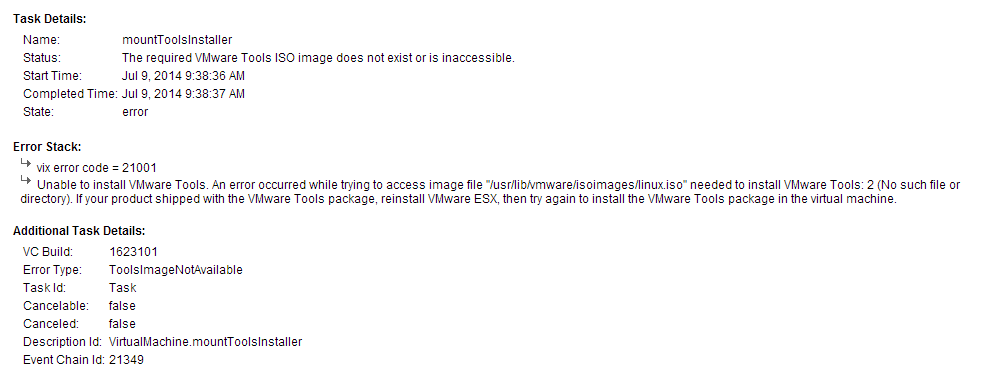
Today I stumbled over a nice workaround. While installing a CentOS 6 VM, I needed to install the VMware Tools. I don’t know why, but I got an error message, regarding a non accessible VMware Tools ISO.

Patrick Terlisten/ vcloudnine.de/ Creative Commons CC0

Patrick Terlisten/ vcloudnine.de/ Creative Commons CC0

I remembered a blog post I read a few months ago, about a VMware online repository, from which VMware tools can be installed. You can download the repository information here. The RPM for RHEL can also be used for CentOS. Simply download and install the RPM: